
Key Updates to Performance Max
Google has rolled out a number of improvements to enhance advertiser control and reporting features. These features enable advertisers to optimize campaigns and make informed decisions faster.
1. Improved Google Media Controls
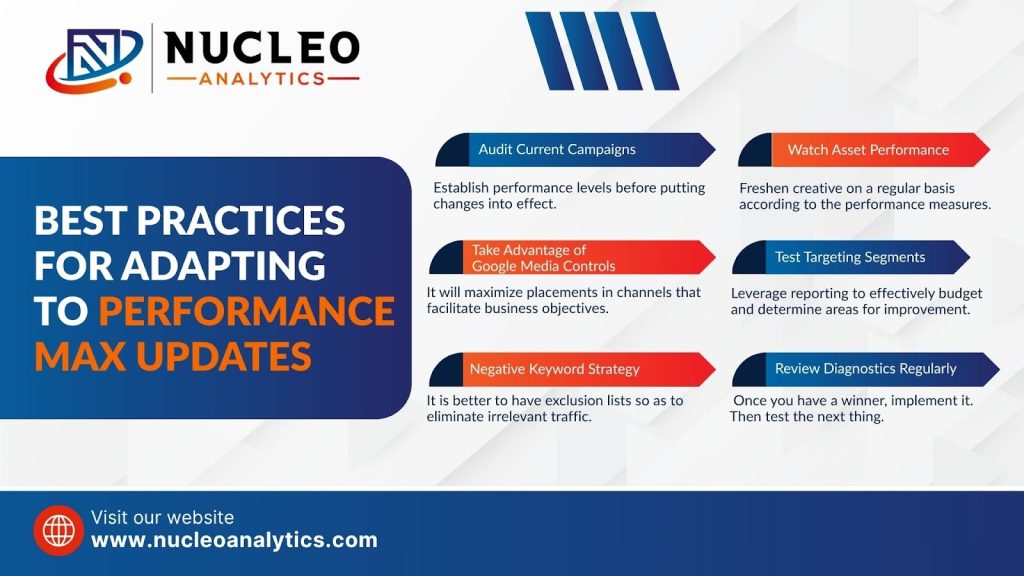
Advertisers get more detailed Google Media Controls, providing them with additional control over ad placement and ad format across various channels. You can now set priority on specific channels or formats, like YouTube video ads or Display placements, depending on your campaign objective.This enhancement guarantees that your ads are hitting the appropriate audience in the appropriate context. Placements are managed optimally to reduce unnecessary expenditure by the companies and maximize conversion. These controls come in particularly handy when dealing with service businesses that have to focus on high-value audiences but do not have to spend a lot of money on low-value channels.
2. Extended Negative Keyword Capabilities
Negative keyword control was one of the weaknesses of the past Performance Max campaigns. In its current form, Google has campaign-level negative keyword lists to allow advertisers to block low-quality or irrelevant search queries.This change will ensure the ad expenditure is focused on intentional searches, maximizes ROI, and upholds brand integrity. In the case of service companies, e.g., one can exclude such search terms as free or cheap or the name of the competitor, which is unlikely to result in a conversion. It is important to maintain these lists of negative keywords because campaigns are effective as searcher behavior varies.
3. Demographic and Device Targeting
Performance Max also now enables more accurate demographic targeting, such as age and gender (gender targeting is in beta). Device targeting enables the ability to target delivery across desktops, tablets, and mobile phones.These new features provide marketers with the option to target those most likely to convert. For example, a B2B app may prefer to target desktop users in certain age ranges, whereas a mobile-first application may target young mobile users. The effect is more targeted ad delivery, fewer wasted impressions, and better campaign effectiveness.
4. Asset-Level Reporting
Among the most significant additions are asset-level reporting that enables advertisers to monitor the performance of individual creative elements such as headlines, descriptions, images, and videos. This allows companies to readily identify the best-performing assets and shut down or overhaul their worst-performing assets.Before, there wasn’t much information on what particular assets drove conversions. With these releases, companies can use an ongoing process of improvement: testing fresh creatives, observing performance, and making regular tweaks so that campaigns stay optimized. Google says that this is making automation work more effectively while providing marketers with control that matters.
5. Channel Performance Insights
Channel-level reporting is another major improvement. Individually, advertisers can now see impressions, clicks, and conversions by channel, whether it is Search, Shopping, Display, YouTube, Gmail, Discover, or Maps.Such revelations guide the marketers in identifying the good and bad channels and making intelligent budget choices. In case one channel is not doing well, then you can make minor modifications to the creative or targeting to improve performance. In the event that a channel is converting at a cheaper rate frequently, the finances can be channeled to produce the highest ROI.
5. Channel Performance Insights
Channel-level reporting is another major improvement. Individually, advertisers can now see impressions, clicks, and conversions by channel, whether it is Search, Shopping, Display, YouTube, Gmail, Discover, or Maps.Such revelations guide the marketers in identifying the good and bad channels and making intelligent budget choices. In case one channel is not doing well, then you can make minor modifications to the creative or targeting to improve performance. In the event that a channel is converting at a cheaper rate frequently, the finances can be channeled to produce the highest ROI.
6. Improved Conversion Tracking and Diagnostics
Improvements in diagnostics and tracking guarantee campaigns go smoothly. Google now alerts advertisers to problems like missing tags, conversion goal misconfigurations, or incomplete account configurations. In addition, new customer reports are also improved, which allows marketers to estimate customer acquisition cost more accurately and distinguish between new and repeat customers.These transformations provide advertisers with an opportunity to make the required changes as soon as possible to ensure that campaigns remain efficient and business-centered.